Part of Portugal
Northern Portugal is a diverse region with coastal areas, hilly landscapes, and mountainous areas. It borders the Galicia region in Spain and the Atlantic Ocean. In the south, the region extends all the way to just below the city of Porto. Northern Portugal (naturally) covers the northernmost part of the country and is therefore a bit cooler than the more southerly regions. In the summer, you can enjoy fantastic cycling here, while it can be very hot in the south during that period.
Along the coast, the landscape is relatively flat. The interior is known for its hills and mountains, where cyclists have the choice of numerous beautiful climbs and routes. The Peneda-Gerês National Park even features some of Portugal’s toughest climbs, with little traffic and well-maintained roads.
The roads in northern Portugal are generally quiet and very suitable for cycling. In the vicinity of Porto, of course, the roads are busier.
Northern Portugal is a fantastic cycling destination if you love authentic, peaceful landscapes. This region still feels unexplored. Yet cycling culture is increasingly gaining momentum here. This is due, among other things, to the various climbs that occur in the Tour of Portugal. Although the Tour of Portugal is not as ‘important’ as the three Grand Tours, the climbs are definitely worth the effort. And although you will undoubtedly encounter other cyclists here, it’s not as crowded as on the famous cols in the Alps or Pyrenees.
By the way, you don’t have to be a hiking enthusiast. The Minho subregion, located in the northwest of Northern Portugal, has a beautiful rolling landscape with vineyards and authentic fishing villages. Minho borders the Peneda-Gerês National Park, where the rolling hills gradually transition into more rugged mountain landscapes.
Another reason to visit this region is the climate. In the summer months, the average temperature here is between 25 and 35 degrees Celsius. That’s warm, but not as warm as in the south. This is also Portugal’s greenest region. That’s thanks, of course, to the fact that it rains more here – and that’s a good thing.
In northern Portugal you will find mainly many vineyards and rolling landscapes. Popular areas are Minho, in the northwest, or the Douro region (east of the city of Porto).
Minho is greener and cooler due to its location along the Atlantic Ocean. The area is hilly, but the northeast of Minho is at the foot of the Peneda-Gerês National Park; it is Portugal’s only National Park. That is the place where you can find some beautiful climbs.
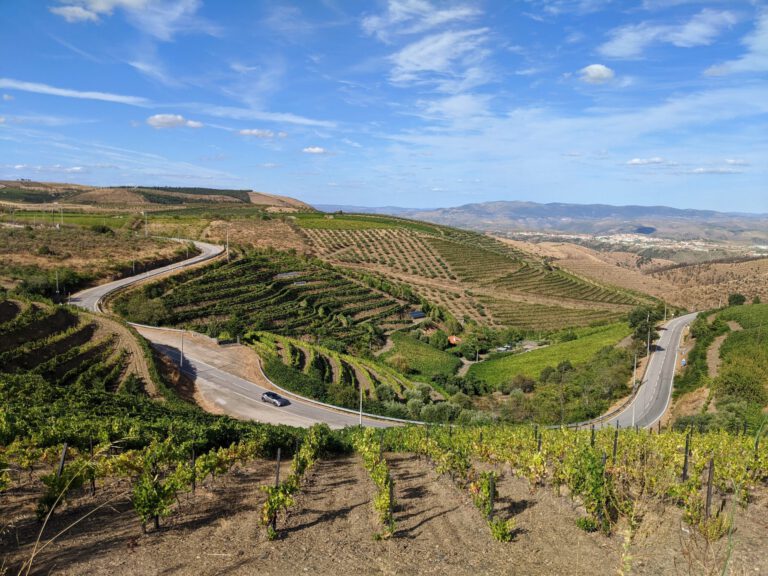
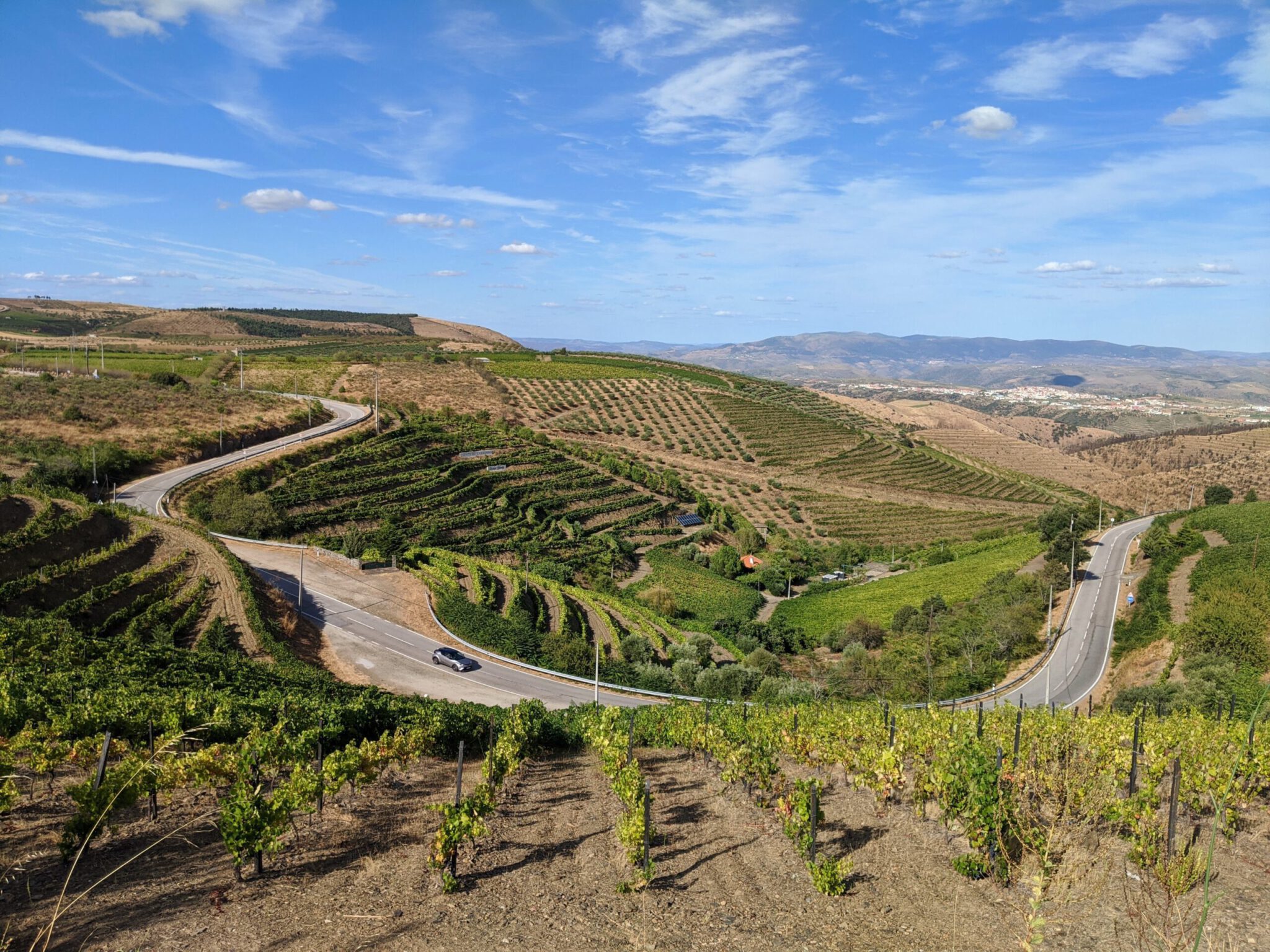
The Douro Valley is somewhat drier and sunnier. The landscape here consists mainly of terraced vineyards (this is the area of the Port!) and river landscapes. Here you can already discover a number of routes from Porto and the Douro Valley. We’ll tell you in advance; although this isn’t necessarily pristine mountain scenery, you’ll still be able to rack up enough elevation gain here!
Trás-os-Montes is the subregion in the northeast of Northern Spain. This area is far from the larger cities. Small, remote villages and the Montesinho mountain range form the backdrop here.
The coastal regions of northern Portugal have a temperate marine climate, with mild winters and not too hot summers. The interior, on the other hand, has a continental climate where the summer days can be hot and the winters cold.
Spring (March – May)
In spring, temperatures in northern Portugal average between 12°C and 22°C. Along the coast and in the Douro Valley, wine-growing begins to take off. During this period, the region experiences an average of 10 to 15 rainy days per month, but there are also an average of 9 sunny days, especially in April and May. The number of dry days increases, but it usually does not rain all day.
Summer (June – August)
The summers in Northern Portugal are cooler than in southern Portugal. Along the coast, temperatures usually remain between 22°C and 28°C, while inland, such as in Trás-os-Montes and the Douro Valley, can regularly reach above 30°C. In the mountains, it is slightly cooler. Rain is rarer during this period, with an average of 3 to 7 rainy days per month.
Autumn (September – November)
The average temperature in September is 14°C to 24°C, and then temperatures continue to drop towards the winter period. The Douro Valley is beautiful during this period, when the vineyards take on beautiful autumn colors. Rainfall gradually increases, with 8 to 14 rainy days per month, but in September you usually still enjoy plenty of beautiful, sunny days.
Winter (December – February)
Winters in northern Portugal are mild along the coast, with temperatures between 8°C and 15°C, but in the mountains and inland it can get considerably colder. In high-altitude areas such as Montesinho and Serra da Estrela, it can snow, which makes cycling difficult there. In lower-lying regions such as Minho and the Douro, cycling is still possible. This is the wettest period of the year, with an average of 12 to 20 rainy days per month, but it usually doesn’t rain all day. There are 4 to 7 sunny days per month during this period.
Travel tips
- Best destination: Porto is a great base if you prefer to stay in or near the city. If you arrive by car or rent a car, we recommend visiting several places in the area to see the best of Northern Portugal. Prefer to stay in a fixed location? Then you’re in good hands at the foot of the Peneda-Gerês National Park, such as Salamonde or Rio Caldo. From there you can head into the mountains, but also take rolling rides through the vineyards and visit historic villages.
- Traffic information: The roads are quiet and generally well maintained. However, keep in mind that the roads near cities can be busier and more chaotic. In the interior, the roads can be narrow.
- Culinary: Of course, you have to drink a glass of Port in the region of Porto! But besides that, Northern Portugal is also known for its traditional dishes, such as Bacalhau à Brás (mackerel with potatoes and eggs) and Francesinha (a hearty sandwich from Porto). You can also enjoy various local cheeses here, freshly grilled fish (especially in the coastal villages) and sweets such as Pão de Ló (a fluffy cake).
When are you leaving?
In the early winter it was still a bit chilly, but from March onwards it is lovely to cycle. You can still enjoy the weather here in the summer, thanks to its location on the coast.
How do you get there?
- Flying: Fly to Porto. Bring your own bike; book a place for your bike box in time.
- By train: Convenient stations: Porto · Braga.
- By car: From Utrecht you are there in about 19 hours. North PortugalPlan an overnight stop along the way, or drive in two days.
This is how we calculate: We calculate distances and travel times starting from Utrecht. Our flights always depart from Schiphol, Rotterdam The Hague Airport or Eindhoven Airport. Want to know how to travel from your place of residence the best way? Let us know, We are happy to help you. After all, we built this site together.
Are you flying? Read our guide Flying with your bike: Which airline, what the cost is and how to pack your bike.