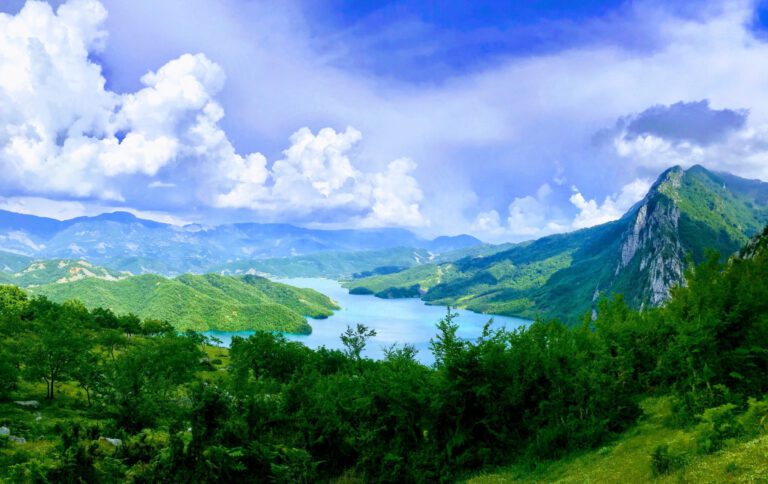
Albania has long been a white spot on the cycling map. That is changing quickly. The country is mountainous, the roads inland are quiet, and the people are welcoming. You can travel from the Albanian Alps in the north to the Ionian coast in the south in a week. Expect adventure: not every road is clearly marked on the map, and the asphalt can change from one kilometer to the next into gravel.
Why cycle in Albania?
- Bergen without the crowds: long climbs where you see very few cars for hours on end.
- The Albanian AlpsAround Theth and Valbona there are rugged valleys. The road to Theth is now paved, and the surroundings are a gravel paradise.
- The coastThe Llogarapas (1,027 m) climb up from the sea and descend on the other side to the Albanian Riviera around Himarë.
- Trans DinaricaThe cycling route through the Western Balkans runs in 11 stages (575 km, over 10,000 meters of elevation gain) through Albania, from Lake Shkodër to Lake Ohrid.
Gravel and bikepacking
For gravel riders and bikepackers, the north is the most interesting part. A classic route is the Shkodër – Theth – Valbona loop, with the ferry across the Koman Lake: a narrow reservoir between steep rock walls, where you simply get on your bike and go. Bring plenty of food: villages are far apart and shops are small.
Road bike
With the race bike, you should choose the south coast and the mountains behind it: the Llogarapas, the coastal road along the Riviera, and the climbs around Gjirokastër. Note: main roads can be busy and there are no shoulder lanes everywhere. Ride early in the day.
Vlorë: the coast as a base of operations
Vlorë, on the southern coast opposite the tip of Italy, is a good starting point. The city is located on the EuroVelo 8, the cycling route along the Mediterranean Sea, and there is a boat to Brindisi. From Vlorë you climb to the Llogarapas: from the northern side it is 13.7 kilometers with 861 meters of elevation gain (average 6.5%). From above you can see the Ionian Sea. On the southern side you descend to Dhërmi; those who want to return have a longer climb from that side with ups and downs of up to 13%.
Those who have more time drive a round of about 400 kilometers: from Llogarapas to the Riviera, via Sarandë and the stone town of Gjirokastër (UNESCO World Heritage Site), and back to Vlorë through the interior. Then you see the coast, the mountains and history in a few days.
The Trans Dinarica through Albania
The main route of the Trans Dinarica in Albania has 11 stages: 575 kilometers and over 10,000 meters of elevation gain, of which 97% are on asphalt. It starts from Gusinje in Montenegro and enters the Albanian Alps, passing through Tamarë to Shkodër and by ferry over the Koman Lake to the east, via Kukës and Peshkopi to Lake Ohrid. A side branch goes from Dushaj gradually climbing 41 kilometers to Valbona.
The Komanmeer
The ferry travels about 33 kilometers through the Drin gorge, from Koman to Fierza: one of the most beautiful stretches of the entire route. There are two companies (Berisha and Alpin) operating, usually one trip per day in each direction in the morning. Check the current times in advance and preferably stay overnight near Koman. Your bike goes with you, but is often packed so tightly that you can’t bring it with you on the journey.
Gravel: Theth and the Mali i Shoshitpas
For gravel riders, the real adventures lie in the side routes. From Bogë, you climb 12 kilometers over a pass to Theth. From Theth, the route continues to the Mali i Shoshitpas: 30 kilometers, of which 84% are unpaved, with a heavy, technical climb after the bridge over the Shala. Then you descend in 50 kilometers to Shkodër, half of it on gravel. This is only for experienced riders with a light bike; it is almost impossible to do it hard. Work is being done on this road, so ask at the location for the current status. A simpler gravel section is the Moglicë – Korçë stage (53 km, about a third unpaved).
Please note: in the summer of 2026, a highway will be built between Librazhd and Përrenjas. Cycling is possible, but with dust and gravel. You can also take the bus there, or choose another route to Lake Ohrid.
Your Cycling base
- Shkodër: in the north, at the largest lake in the Balkans. Starting point for Theth, Valbona and the Koman Lake.
- Tirana: The lively capital with the airport. Convenient for a first and last night and to rent a bike.
- Vlorë: the coast, the Llogarapas and the Riviera.
- Gjirokastër and Berat: Stone towns on hills, well combined in a multi-day trip through the south.
Food and accommodation
In the mountains you sleep in a bujtina: a family-run guesthouse where you eat what comes on the table that day, often from their own garden. Along the coast there are hotels and apartments. Food is cheap and good: byrek (a savory puff pastry), grilled fish by the coast, lamb and fresh cheese in the mountains.
Read our story too Cycling destination Albania: exploring the region from Vlorë.
When are you leaving?
April to June and September to October. In July and August it is very hot along the coast and in the valleys. In the Albanian Alps, snow lies on the highest passes until May.
How do you get there?
Fly to Tirana; there are direct flights from the Benelux. Bike rental and organized tours are becoming more and more common, especially in Tirana and Shkodër. Euros are widely accepted, but bring Albanian lari for the interior as well.
Sources
- Trans Dinarica – stages and GPX through Albania
- Trans Dinarica: Albania – stages, ferry to Komanmeer, gravel at Theth
- Personal story: Cycling destination Albania: exploring the region from Vlorë – Llogarapas and round through the south
Stories
This is how we calculate: We calculate distances and travel times starting from Utrecht. Our flights always depart from Schiphol, Rotterdam The Hague Airport or Eindhoven Airport. Want to know how to travel from your place of residence the best way? Let us know, We are happy to help you. After all, we built this site together.
Are you flying? Read our guide Flying with your bike: Which airline, what the cost is and how to pack your bike.