Part of France
Cycling in the Pyrenees
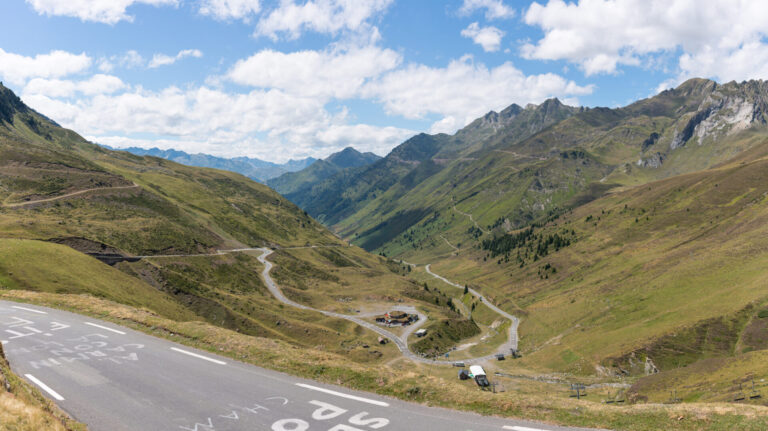
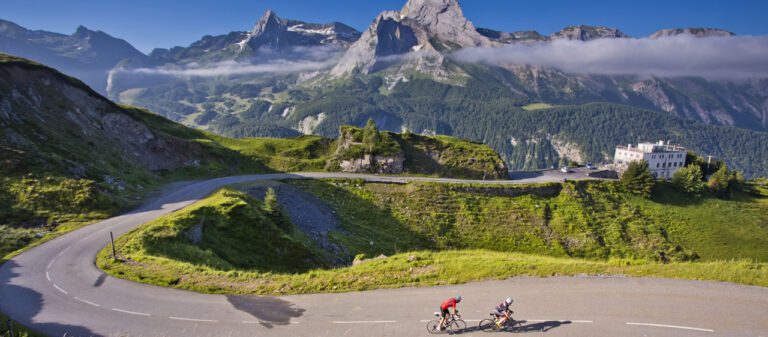
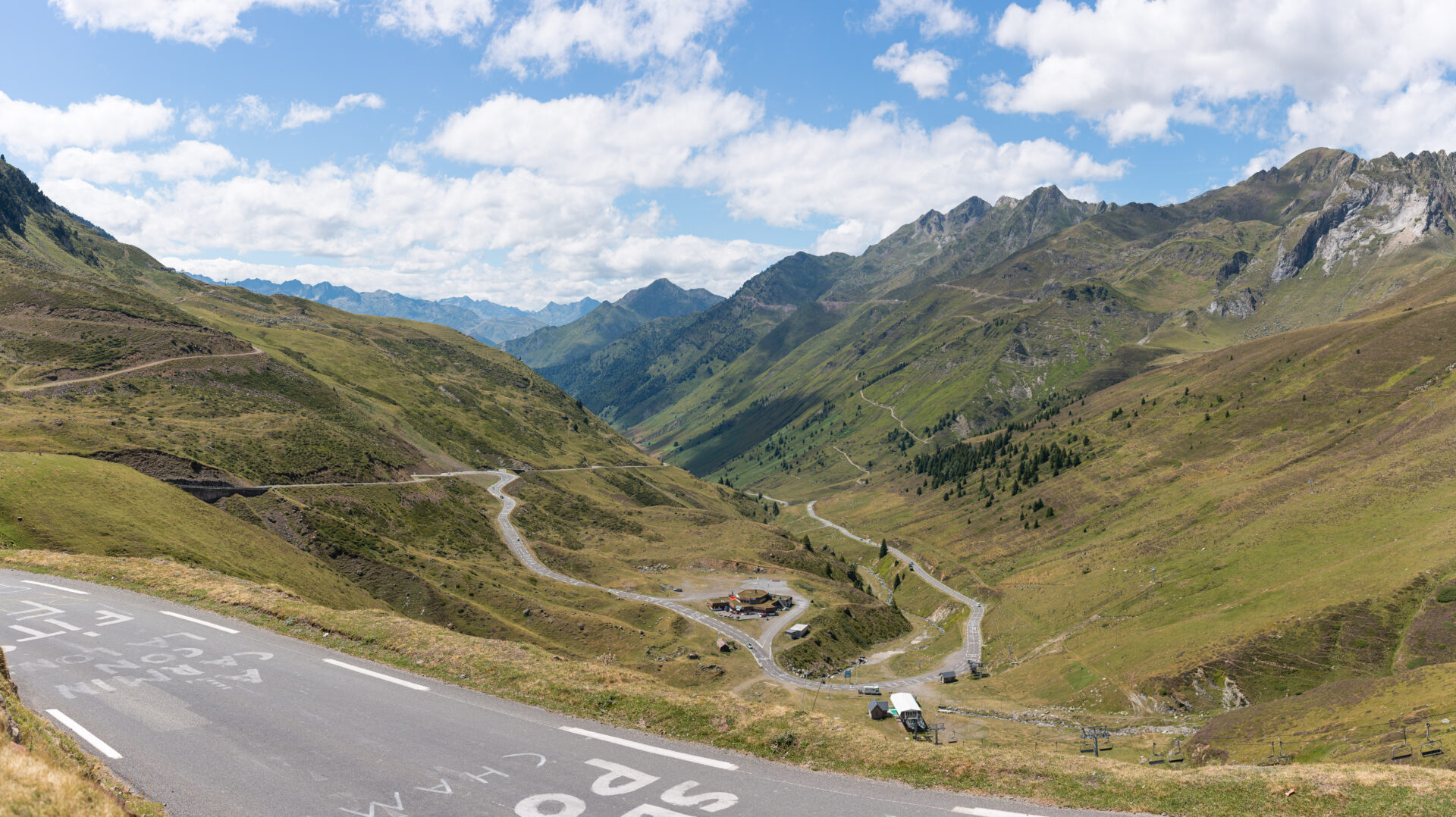
The impressive Pyrenees stretch over a length of approximately 430 kilometers on the border between Spain and France (with the small state of Andorra in the middle). The mountain range is home to many iconic climbs. You might recognize them from the Tour de France; the impressive Col du Tourmalet or the Col d’Aubisque. Year after year we see the best riders in the world tackle these climbs. These are climbs that you should have cycled in your life as a cyclist! Moreover, this mountain range has much more to offer; authentic villages, a diverse landscape, and a rich culture. And did you know that you don’t even need to be an expert cyclist to cycle in the Pyrenees? Every cyclist can find great routes here, whether you want to climb the highest peaks, explore gravel paths, or take more leisurely rides through the beautiful valleys.
How are the Pyrenees different from the Alps?
The Pyrenees are distinguished from the more well-known Alpine mountain range by their predominantly granite and limestone landscape. Where the Alps are more undulating, the Pyrenees are truly rugged with rocky outcrops and steep slopes. Although the Pyrenees are lower than the Alps – the highest peak is Aneto at 3,404 meters – cycling here is not necessarily easier. Ascents are less gradual. In the Alps, you can more easily find a steady climbing rhythm; something that in the Pyrenees becomes more difficult.
What is the best destination for cycling in the Pyrenees?
The Pyrenees are extensive and therefore extremely diverse. Therefore, every cyclist can find a suitable destination here. First of all, you might ask yourself whether you would prefer to stay on the French or on the Spanish side. In general, the southern, Spanish side of the Pyrenees is sunnier and drier than the French side. The French side is greener. Most of the famous climbs are located on the French side. You will notice that the roads on the French side are well maintained. In Spain, the atmosphere and culture feel more authentic. There are fewer well-known climbs, but it is also less touristy. The Spanish side is fantastic if you are more adventurous and want to discover more unknown places. Choose the French side if you want to be sure of good roads, want to cycle iconic climbs, and are looking for an area with the best facilities for cyclists, such as many options for bike rentals.
Click on one of the destinations below to learn more about the area and nearby climbs. We’ll start on the west side – at the beautiful Vallée d’Ossau – and end there where the mountain chain meets the Mediterranean Sea, in the cycling capital of Girona!
Popular cycling destinations in the Pyrenees
Vallee d’Ossau
The Vallée d’Ossau is located in the Nouvelle-Aquitaine region in France. This valley offers a peaceful alternative to the more touristy Argelès-Gazost, which is known as the starting point for many famous climbs. From both locations, you can climb the iconic Col d’Aubisque, but the Vallée d’Ossau stands out for its serene, authentic character. Besides the Col d’Aubisque, you can also tackle other stunning climbs from the valley. This makes it a perfect base for cyclists who want to explore the most beautiful routes in the Pyrenees from a peaceful environment.
- Col du Pourtalet
- Col d’Aubisque (west side)
- Col de Marie-Blanque
Vallée des Gaves
An hour’s drive east from Vallée d’Ossau – see previous paragraph – and you’ll find yourself in Vallée des Gaves, with the town of Argelèz-Gazost as an ideal base for the most famous climbs in the region. This area is more touristy and lively.
- Col du Tourmalet
- Col du Soulor
- Col d’Aubisque (eastern side)
- Hautacam
Argelès-Gazost
A third good option is to head east. From here, too, you have plenty of well-known climbs around you, and the town has plenty of options for rental bikes, bike shops, and nice accommodations. Climb from here to:
- Col du Tourmalet
- Col d’Aubisque
- Hautacam
Read more information about Argeles-Gazost as a cycling destination here.
Luchon is one of the most visited cities in the Tour de France. It has often served as a starting or finishing point for stages in the Pyrenees. This is partly due to its strategic location at the foot of several iconic cols. However, Luchon is also a spa town, making it an attractive destination for cyclists who also want to relax.
- Col du Tourmalet
- Col de Peyresourde
- Col de Portillon
- Col de Superbagnères
This small country in the Pyrenees is known to cyclists for the challenging climbs that are often part of the Tour de France and Vuelta a España. With elevations of up to over 2,000 meters, Andorra offers steep climbs and breathtaking views. The mountains here have a more rugged, alpine character compared to the flatter climbs elsewhere in the Pyrenees. Professional cyclists like to train in Andorra to train at altitude on quiet roads.
- Coll de la Gallina
- Ordino-Arcalís
- Coll d’Ordino
- Collada de Beixalis
Pyrénées-Orientales
Pyrénées-Orientales is a department in the south of France, located in the Occitanie region. It is on the border with Spain, and has a unique combination of mountainous terrain and a coastline on the Mediterranean Sea. This makes it a fantastic destination for cyclists who are looking for both challenging climbs and more relaxed routes along the coast.
Did you know that this area has strong Catalan influences? Thanks to the historical ties between this region and neighboring Catalonia, you can hear many locals speaking Catalan in this French department, for example.
- Col de la Creu
- Col de Jau
- Col de la Llose
Read all about Femke's experience in the Pyrénées-Orientales here!
Catalan Pyrenees
Further south you will find yourself in the Catalan Pyrenees. This area is less populated than the Pyrénées-Orientales and offers more pristine nature and quiet, isolated roads.
- Vallter 2000
- Port de la Bonaigua
- Coll de Nargó
Discover more about cycling in Catalonia here!
Girona is the cycling capital of Europe. Many professional cyclists live here to train or spend the winter. Both the paved roads and the gravel routes in the area are fantastic. In the old town, you will also find several beautiful cycling cafes, making you feel truly like you are in a cycling paradise. Girona is located at the foot of the Catalan Pyrenees. From the city, you can therefore cycle fantastically in the foothills of the mountain range. It is an ideal destination if you are looking for a cycling destination where it is usually nice weather and you can cycle up the mountains, but also do less strenuous hikes. Both gravel enthusiasts and cyclists can find something to their liking here.
During your stay in Girona, make sure to climb the Els Àngels climb; the favorite climb of many runners who stay in the city. With an average incline of only 3.6% and a length of about 10 kilometers, this is a popular climb. Not too tough, but perfect for training and with beautiful views.
Want to learn more about cycling in Girona? Check out this article.
Long-distance routes and award-winning cycling regions
- Vélosud (650 km, Biarritz – Le Barcarès): along the foothills of the Pyrenees, from ocean to sea.
- La Scandibérique / EuroVelo 3 (1700 km, Jeumont – Estérençuby), which ends in the Basque Country.
- La Méditerranée by bike (850 km, Le Perthus – Menton), which begins at the Spanish border.
Tourmalet – Pic du Midi, Perpignan and Cap Sud 66 were awarded the title of Destination France à Vélo in 2026.
Your Cycling base
The Pyrenees are extensive; choose your base of operations on the cols you want to ride:
- Argelès-Gazost or Luz-Saint-SauveurFor the Tourmalet, Hautacam, Luz-Ardiden and the road to Gavarnie.
- Lourdes: well accessible by train and plane, with the Soulor, Aubisque and Hautacam within easy reach.
- Bagnères-de-LuchonFor the Peyresourde, Superbagnères and the Col de Portet d’Aspet.
- Saint-Lary-Soulanat the foot of the Col de Portet and the Pla d’Adet, with the Aspin and the Azet nearby.
Climber map: the most important climbs
On this map you can see the most important ascents in the area. Choose a starting point to see only those climbs. Click on a point for the altitude and the climb numbers. For the yellow points we have a route with GPX.
More stories about Pyrenees
Sources
- France Vélo Tourisme: cycling routes – long-distance routes
- Destinations France by Bike 2026 – award-winning cycling regions
When are you leaving?
How do you get there?
- Flying: Fly to Toulouse · Pau · Lourdes. Bring your own bike; book a place for your bike box in time.
- By train: Convenient stations: Lourdes · Pau · Toulouse.
- By car: From Utrecht you are in about 12 hours PyreneesPlan an overnight stop along the way, or drive in two days.
This is how we calculate: We calculate distances and travel times starting from Utrecht. Our flights always depart from Schiphol, Rotterdam The Hague Airport or Eindhoven Airport. Want to know how to travel from your place of residence the best way? Let us know, We are happy to help you. After all, we built this site together.
Are you flying? Read our guide Flying with your bike: Which airline, what the cost is and how to pack your bike.