

Do you want to go mountain biking in a country where you will be constantly amazed by the changing landscapes? From green mountain ranges to desert landscapes, and from coastal areas to arid highlands? In Spain You have everything. Why would you visit just one single destination in Spain? With a bikepacking trip, you’ll get to places you wouldn’t normally visit. It gives you the chance to discover the real Spain and visit the most beautiful spots. In this article, we share four bikepacking routes in Spain that showcase the country’s unparalleled diversity.
1. Badlands: 750 kilometers through desert terrain
Badlands is an extreme bikepacking race in southern Spain, which takes place in the remote badlands of Andalusia takes place. The route covers approximately 750 km, with more than 15,000 vertical meters, and runs through, among other things, the Tabernas Desert and the mountainous region of the Sierra Nevada. You climb the highest col in Europe (Pico Veleta), but you also cycle along the coastal area near Almería. During the race it is usually very hot, which makes it even more difficult for the participants. Fortunately, you can also ride this route excellently as a bikepacking tour!
2. The Silver Route: 1000 kilometers of cycling along Roman trade routes
The Silver Route was originally a Roman trade route Sevilla to Gijón in the northn, running through the interior of Spain. There is both a paved and an unpaved variant of the route, allowing you to ride the route on a gravel bike or race bike. The Silver Route is longer than the Badlands route mentioned above, but less technically challenging and has a much lower elevation gain; about 8,000 to 10,000 depending on the exact route you choose. You cycle through beautiful historic cities, such as Cáceres, Where time seems to have stood still. Cross the dry plains of Extremadura, and end up in the green hills of Asturias.
This route closely resembles the pilgrimage route from Seville to the Camino de Santiago. The route is largely the same, but ends in the pilgrim city Santiago de Compostela, in Galicia. From León the routes are separated from each other.
3. Empty Mountains: 680 kilometers through ‘Spanish Lapland’
The Montañas Vacías route is a challenging off-road biking route through ‘Spanish Lapland’; which refers to the Celtiberian Serranía, an extensive and sparsely populated area in Spain, spread over 10 provinces, including Teruel, Guadalajara and Cuenca. This area is so sparsely populated that it is comparable in terms of inhabitants to areas in the Scottish Highlands or Lapland.
The route has a length of 680 km and includes more than 12,000 meters of elevation difference. It crosses remote areas such as the Montes Universales and Sierra de Gúdar, and is mainly gravel. The route begins and ends in Teruel, where the landscape is already very impressive right away. Shorter versions of the route are also available., That way, you can choose routes between 150 and 700 kilometers.
Read all about the Montañas here Vacías route on the official website.
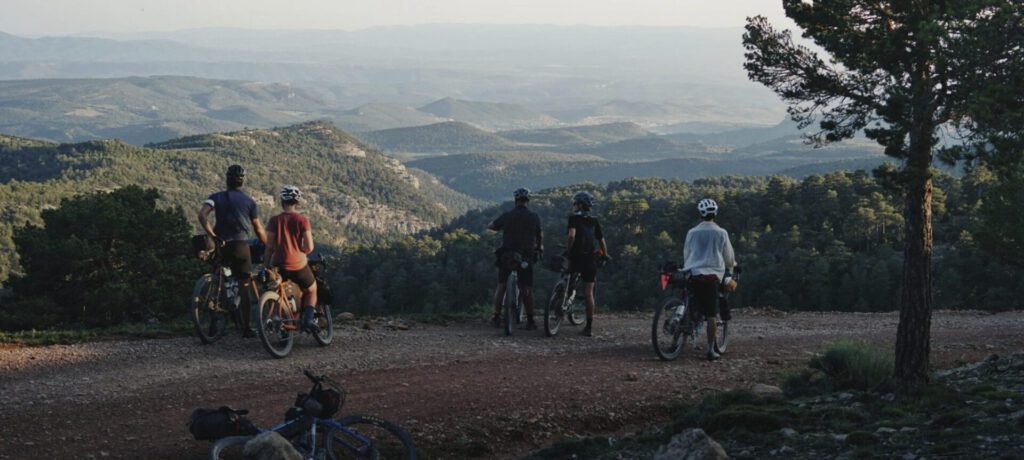
4. Altravesur: cross authentic southern Spain in 1340 kilometers
The Altravesur bikepacking route shows you the beautiful, authentic southern Spain. The route starts in Cadiz, then crosses through various beautiful nature parks such as Los Alcornocales Nature Park, Sierra de Grazalema, Sierra Nevada en Natural Park of the Sierras de Cazorla – to name just a few. The route ends after 1340 kilometers and 33,528 meters of elevation in the lively city Valencia on the east coast. Take your time on this route; the Altravesur is 85% gravel and requires a good dose of perseverance and fitness. But then you’ll end up in insanely beautiful places!
Read all about the Altravesur route on the official website.
Tips for your bikepacking adventure in Spain:
- Choose the region that suits you best. The north is greener, but also wetter. In the south you find more dry desert landscapes, but in the summer months it can be very hot there.
- Be aware of the climate; Spain has a wide variety of climates and extreme temperatures. For example, in higher altitudes like the Sierra Nevada – where several routes run through – it can be very hot, but also very cold. In the autumn and spring months, you usually have good weather.
- If you choose a route in pristine areas, check first where the water points are before setting off. You won’t always encounter villages, and during the siesta, smaller supermarkets are usually closed.
- Bring enough food with you, but remember that food in restaurants is very cheap in Spain. That saves you packing again!
- Wild camping is not allowed in nature parks, on beaches or within a radius of 1 km from villages or towns. In some places it is even tolerated or allowed. Check this in advance. Fortunately, campsites – especially in the interior – are often very affordable.
Questions & tips
Do you have any questions about this route, or have you been there yourself? Share them here. We read everything and usually respond within a few days.