
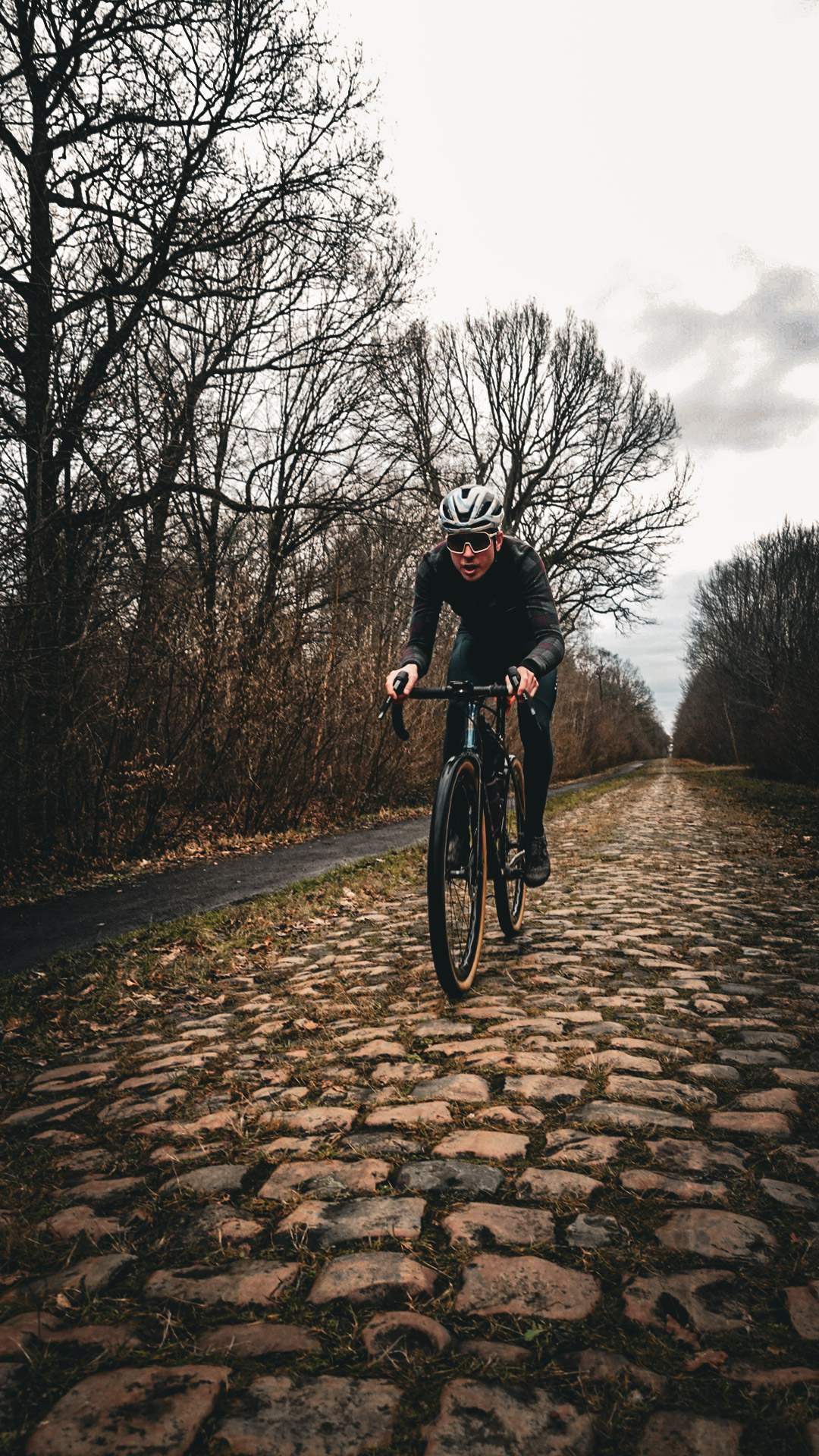
On the one hand, we fear them; on the other hand, they keep calling us ‘kasseienstroken.’ While the French region of Nord-Pas de Calais (on the border with Belgium) is known for its many farmer fields, that is not what we cyclists are looking for here. We come for the iconic kid-head caps from the classic Paris-Roubaix race, which takes place in mid-April again. Of course, the race is even more fun to follow when you’ve experienced for yourself what a “hell” it feels like to have kid-heads under your 28 mm tires. Therefore, we have already selected five tracks that you should try yourself this spring. Consider this your checklist for a bike weekend in Nord-Pas de Calais!
Photos by: Sander Kolsloot, Adobe, Thomas Bogaard
The cobblestones of Paris-Roubaix; what can you expect?
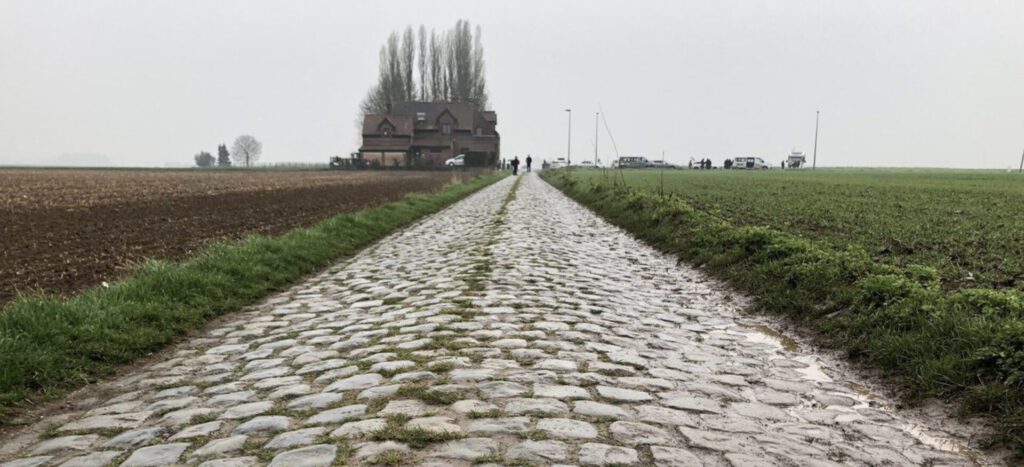
The magic of ‘Parijs-Roubaix’ attracts many cycling tourists to this area every year. It’s those cyclists who, despite the odds, still want to take the plunge and try it out. ‘Mons-en-Pévèle’ of ‘Carrefour de L’Arbre’ We want to drive. Or well, drive? Maybe we should use the word ‘shuddering’. You already know in advance that the long stretches of gravel are ‘hellish’. Even as you’re shaking, you’ll wonder why you started this ride. But at the same time, you’ll mostly experience pleasure; what a crazy thing these stretches are. And what a hassle, those pros who drive this gravel classic.
Tips for a gravel bike ride? Lower your tire pressure, keep the handlebars loose, and use your arms to absorb the bumps. Perhaps most importantly: make sure you keep up a steady speed. The faster you drive, the easier it will be.
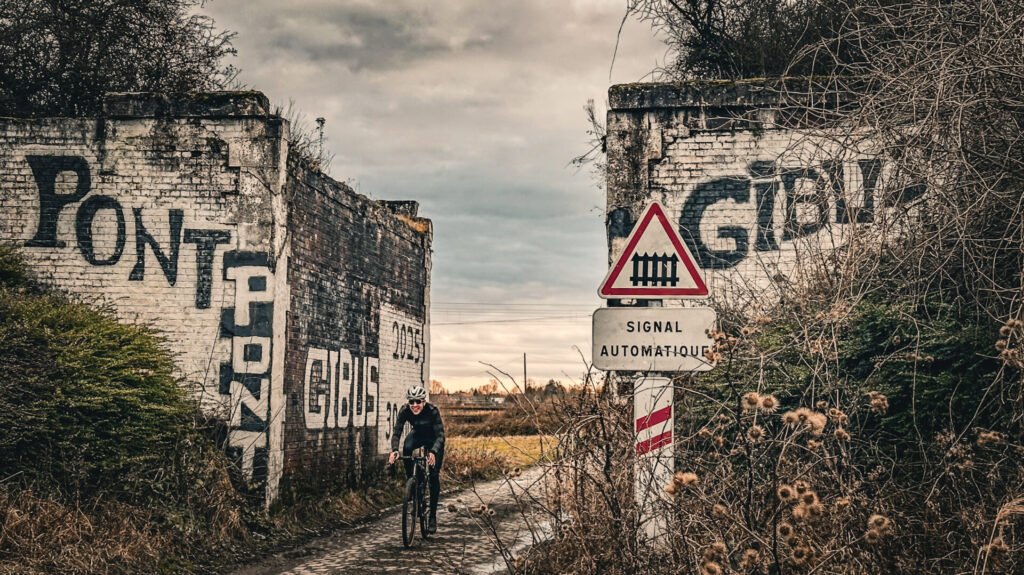
1. Bos van Wallers – Trouée D’Arenberg (5 stars)
This is perhaps the most famous gravel section of Paris-Roubaix, and therefore an absolute ‘must-do’ for your ride in this area. This is really 2.4 kilometers of road, not for nothing this section is also called the ‘King of the Road’. the gate to hell The gravel is rough, uneven, and loose. In addition, there is a slight climb and descent in the section. This stretch is also known for many crashes during the race. The riders enter the forest after a slight descent, causing them to blast down the gravel at high speed. This is not always the case, but it is often the case. During the last edition in 2024, a chicane was added to the course to make the uphill stretch quieter. This was not something that not all riders and teams were enthusiastic about. Therefore, the entire uphill section in the 2025 edition will be adjusted to slow down the speed.
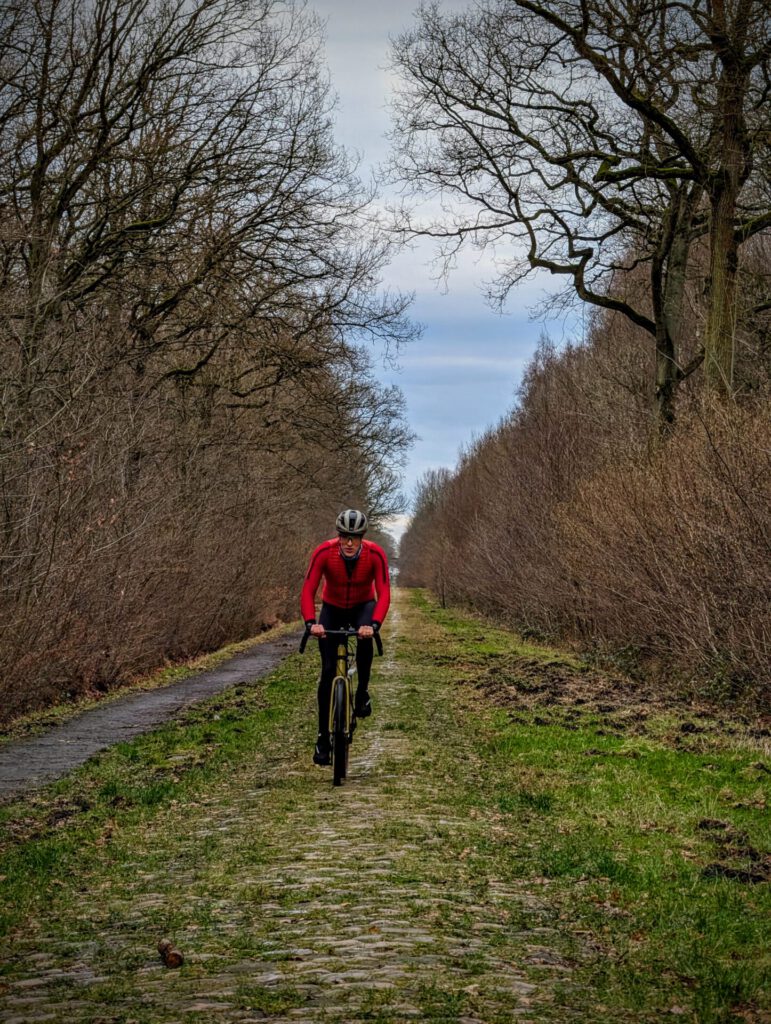
2. Mons-en-Pévèle (5 stars)
Given the location of this stretch, about 45 kilometers before the finish, this is not necessarily a stretch where the race is decided. But with almost 3 kilometers of poor terrain (this one is also rated 5 stars), this is indeed a stretch where the first riders drop out. The stretch starts flat, slopes up, and pushes the riders towards a crucial bend where skill and positioning make the difference. A wrong line, a moment of inattention… And the Paris-Roubaix dream can be gone in a fraction of a second. This is how Johan Vansummeren was stopped on Mons-en-Pévèle in 2010 by a crash. A year later, despite a flat tire, he still managed to win the biggest victory of his career during Paris-Roubaix.
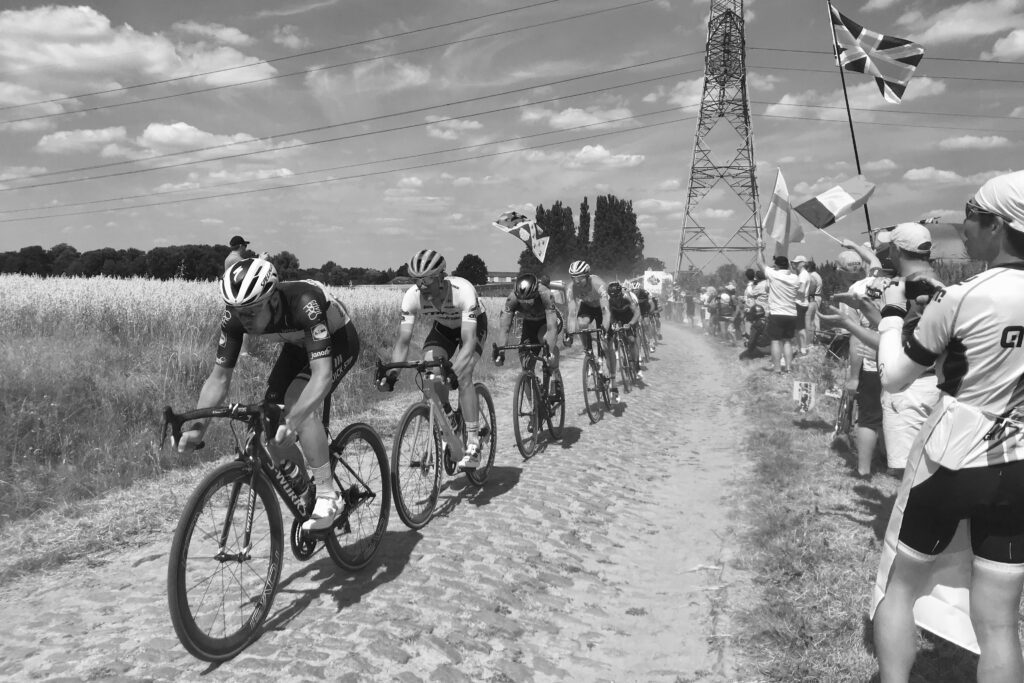
3. Camphin-en-Pévèle (4 stars)
A stretch that fits well in the Hell of the North, because it’s usually not very good there. Where you can still find a (sort of) ‘good line’ on many gravel sections, it’s really all bumpy and crooked here. During the race it’s important that riders are in the front group on this stretch. This is often where the difference is made. Either because riders go for the attack here, but also because there’s still the possibility of a crash here that leaves many riders behind. The riders also know: after just one kilometer past the Camphin-en-Pévèle stretch, the Carrefour de L’Arbre awaits. It’s important to take a good position here. If you want to try it yourself: good luck! There’s no space for a stretch through the grass or a stretch of relief from the persistent hoofed traffic. 1800 long meters, with about halfway a sharp right-hand bend. If you want to cycle the Camphin-en-Pévèle yourself after a rain, you really have to be careful here. It can really be slippery.

4. Carrefour de l’Arbre (5 stars)
After the forest of Wallers, the dirt road of Carrefour de L’Arbre Standardly categorized with 5 stars. Almost immediately after Camphin-en-Pévèle and only 15 kilometers before the finish Is this the moment for those riders who still have a ‘cartouche’ left? The stretch is 2100 meters long. Anyone who sees the stretch with their own eyes thinks: ‘I’m not going to cycle over this with my common sense, am I?’ Exactly: you better leave common sense at home. You’re not doing this for fun, but for the story afterwards. Because then you’ll be looking at the course – with the memories of the screaming and the pain still in your mind – and you’ll come to a certain point where you’ll be thinking: small A bit of what the riders go through.
This is also the The stretch that is forever linked to two-time winner Marc Madiot. This notorious gravel stretch played a decisive role in both of his victories. It is also the stretch of great names Backstedt, Boonen and Cancellara – who fell here after three victories during his last edition, after which Mathew Hayman won. All in all; on this hellish gravel stretch, perhaps the real stories are created. Year after year, the difference is made here.
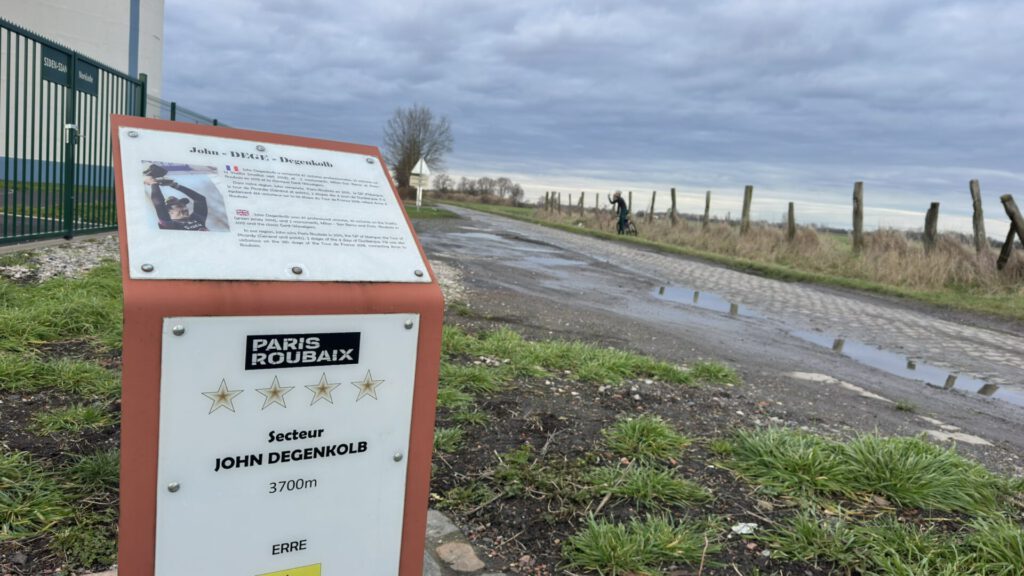
5. Pope John Degenkolb – d’Hornaing to Wandignies-Hamage
When you look at the course, this is not the most beautiful stretch, but it is definitely John Degenkolb’s stretch. At least, the stretch is named after him. With 3700m, it is a big four-star stretch. And one that should be seen, considering Degenkolb’s status as the winner of Paris-Roubaix in 2015.
Taking on the ‘Hell of the North’ yourself?
Every year, several thousand cycling tourists head north to France to test their skills on the cobblestones from Paris to Roubaix. For those who wish to do so, there is the opportunity to cycle (parts of) the classic race themselves. Tip: The Paris Roubaix Challenge – with route options between 70, 140 or even 175 kilometers – there’s one for the books. We wish you all the best! And good luck..

Questions & tips
Do you have any questions about this route, or have you been there yourself? Share them here. We read everything and usually respond within a few days.