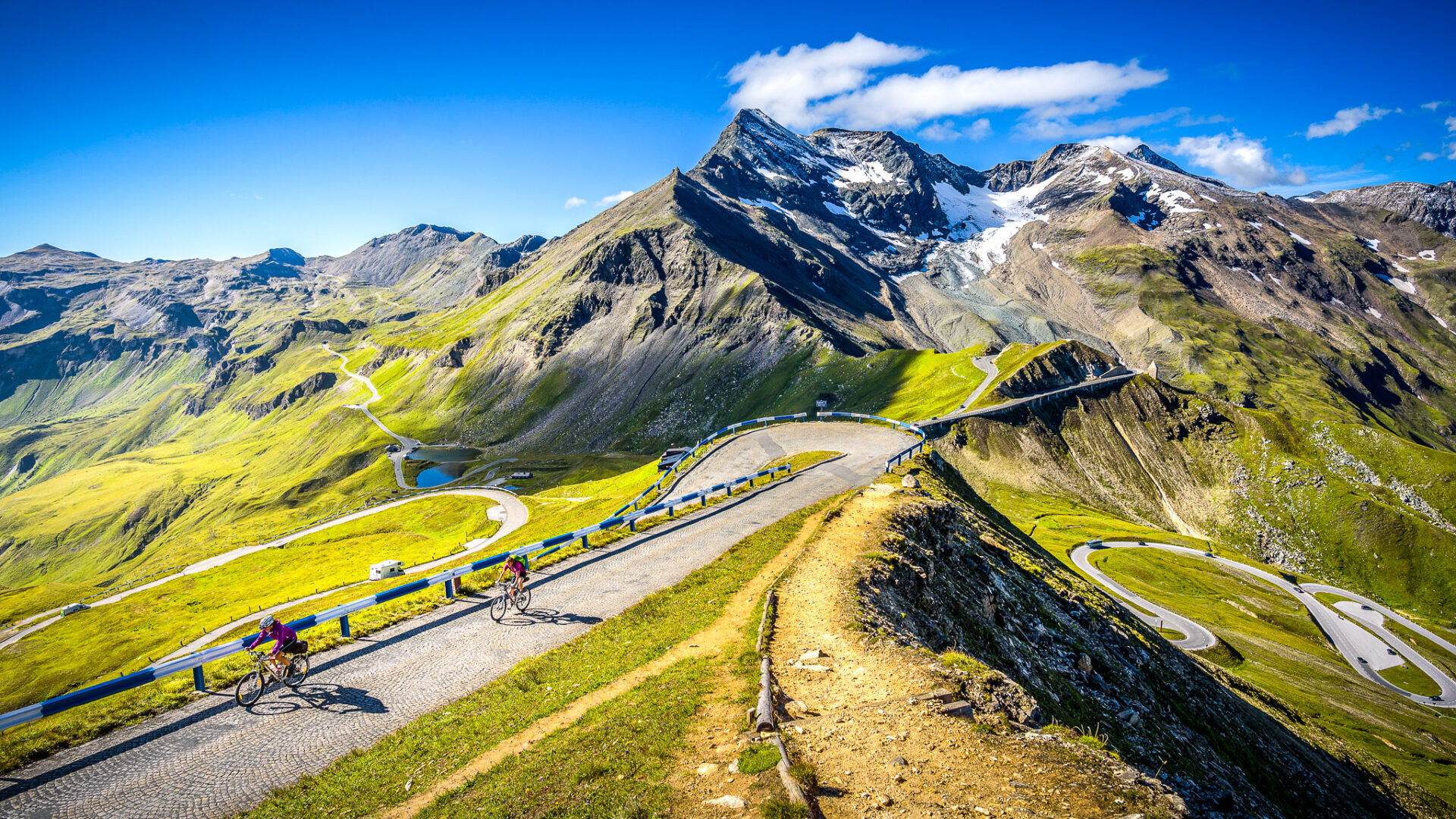
Austria is sometimes underrated as a cycling destination. It has not only the Grossglockner, but also other mighty climbs and gravel routes in the Bregenzerwald, around Saalbach and in Carinthia! Let yourself be surprised by this Alpine Cycling Paradise!
The region
Austria is a paradise for cyclists, with breathtaking mountain landscapes, picturesque valleys, and perfectly paved roads. Whether you are a recreational cyclist or a dedicated cyclist, Austria offers endless opportunities to enjoy challenging climbs, rolling roads, and beautiful nature.
The Best Cycling Regions in Austria
Austria is surrounded by impressive mountain ranges and borders Germany and the Czech Republic in the north, and Italy and Switzerland in the south. Each region has its own character and unique cycling routes.
1. Cycling in Upper Austria & Lower Austria
In the north of Austria lie Oberösterreich and Niederösterreich, two regions ideal for those who enjoy long, leisurely trips through rolling landscapes, forests and vineyards. From Niederösterreich you can also reach the capital Vienna, a perfect starting point for cycling routes along the Danube or through the Wienerwald.
2. Cycling in Styria and Carinthia
Further to the southeast lie Styria and Carinthia, two of Austria’s largest states. Cyclists will find a mix of challenging climbs and fast descents here, while the many lakes in Carinthia provide stunning views. Graz, the capital of Styria, is an ideal starting point for cycling routes through the Alps.
3. Cycling routes in Salzburgerland
In the heart of Austria lies Salzburgerland, one of the most diverse cycling regions in the country. From the rolling hills around Salzburg to the steep climbs in the Hohe Tauern – here you’ll find both challenging mountain passes and scenic cycling routes through valleys and along lakes. Salzburgerland borders on Carinthia and Tyrol, making it easy to combine routes.
4. Cycling paradise Tyrol & Vorarlberg
In the west of Austria, Tyrol and Vorarlberg dominate the cycling scene. Especially Tyrol is known as Austria’s cycling region, with iconic climbs such as the Ötztal Gletscherstraße, the Timmelsjoch Pass and the Kühtai climb. Vorarlberg, the smallest state of Austria, also offers beautiful routes, such as the climbs around Lake Constance and the Silvretta Hochalpenstraße.
Highlights
These are the highlights if you want to go cycling in Austria:
1. Grossglockner Hochalpenstrasse
The Grossglockner Hochalpenstrasse is one of Austria's most famous and challenging climbs. The climb is long, steep and passes through an impressive Alpine landscape with hairpin bends and panoramic views of Austria's highest mountain, the Grossglockner (3,798 m).
- Location: Salzburg/Carinthia
- Distance: 48 km
- Altitude meters: 1,750 m
- Maximum increase: 12%
Leave early in the morning to avoid crowds and (in summer) the high temperatures.
2. Timmelsjoch
The Timmelsjoch connects Austria with Italy and offers a tough but spectacular climb through the Alps. From Sölden, the climb gradually rises with long, challenging sections and beautiful views.
- Location: Tyrol
- Distance: 23.4 km
- Altitude meters: 1233 m
- Maximum increase: 10.3%
The Timmelsjoch is part of the Ötztal Radmarathon and is a favorite among cyclists who are looking for a real challenge. The Italian counterpart, Passo del Rombo is a bit tougher!
3. Kühtai saddle
The Kühtai is one of the toughest climbs in Tyrol and plays an important role in the Ötztaler Radmarathon. The climb from Kematen is long and treacherous, with steep sections and beautiful views of the surrounding mountains.
- Location: Tyrol
- Distance: 23 km
- Altitude meters: 1,400 m
- Maximum increase: 10.8%
For an extra challenge, Kühtai can be climbed from both sides.
4. Silvretta Hochalpenstrasse
The Silvretta Hochalpenstrasse offers a beautiful climb with a steady gradient and well-maintained road. This makes it one of the most enjoyable climbs for cyclists who enjoy long mountain rides. The beautiful part starts in Partenen, where you have the beautiful famous hairpin bends.
- Location: Vorarlberg
- Distance: 13.6 km
- Altitude meters: 900 m
- Maximum increase: 9.8%
The highest point, Bielerhöhe, offers an impressive view of the glaciers of the Silvretta.
5. Kitzbüheler Horn
The Kitzbüheler Horn is one of the toughest climbs in Austria and is known for its extremely high gradient. With an average gradient of 11.5% and peaks of up to 14%, this climb is only suitable for the strongest cyclists.
- Location: Kitzbuhel, Tyrol
- Distance: 10.2 km
- Altitude meters: 970 m
- Maximum increase: 14.6%
This climb is short but intense and is frequently used in professional cycling races.
6. Nockalmstrasse
The Nockalmstrasse is a hidden gem in Austria and offers a long, well-paved climb with hairpin bends and stunning views. This is one of the most picturesque cycling routes in Austria.
- Location: Carinthia
- Distance: 35 km
- Altitude meters: 1,600 m
- Maximum increase: 12%
This climb is ideal for cyclists looking for a challenging but not too busy route. Please note: you have to pay to be allowed to cycle here.
7. Danube cycling path
This is not a climb, but it is the ultimate cycling destination in Austria. For those who prefer not to venture into the mountains, the Danube Cycle Path is a great option. This is one of the most famous long-distance cycling routes in Europe and follows the Danube through the picturesque Austrian landscape.
- Location: Upper Austria/Lower Austria
- Distance: Up to 350 km (can be divided into stages)
- Altitude meters: Very limited
This route is perfect for endurance training and passes by historic cities such as Passau, Linz and Vienna.
8. Ötztaler Radmarathon
The Ötztaler Radmarathon is one of the toughest gran fondos in Europe and attracts thousands of cyclists every year who want to take on this extreme challenge. The route passes through four major passes and has more than 5,500 meters of elevation gain.
- Location: Sölden, Tyrol
- Distance: 238 km
- Altitude meters: 5,500 m
- Maximum increase: 14%
This marathon is one of the ultimate tests for all cyclists (and certainly cyclists) and requires good preparation.
What you need to pay attention to
When planning a cycling holiday in Austria, it is important to take into account the time of year. Many of the popular mountain passes only open late and you also have to deal with seasonal closures of hotels and sometimes entire villages. The beautiful Kühtai only opens in June. Also take a look at the various cycling events taking place in Austria. If you also plan to ride that route during the Ötztal, that is not convenient.
Always remember the local holidays that you need to take into account. Furthermore, Austria, like Switzerland, is a country with a ‘vehicle registration tax’. Furthermore, as an EU citizen in Austria, you don’t have to worry about anything. You are free to walk and stand, and remember: drive only on roads where it is NOT forbidden to drive.
Climber map: the most important climbs
On this map you can see the most important ascents in the area. Choose a starting point to see only those climbs. Click on a point for the altitude and the climb numbers. For the yellow points we have a route with GPX.
How do you get there?
Car: Austria is very accessible by car. It is not close, as most destinations are within a day’s drive (+/- 10 hours). This is without traffic jams and other delays. Carinthia is more than 12 hours by car, so keep that in mind. Innsbruck, the larger region of Tyrol, Salzburgland and Vorarlberg are easily accessible in a day (and they are popular cycling destinations).
Train: The night train to Innsbruck is ideal. You can get on at 7:00 PM and wake up in the mountains at 9:00 AM the next morning. From Innsbruck, you can head out to the rest of Austria. You also have the option to get off in Munich and head towards Vienna. Either way, there are enough options to get there quickly. There are also plenty of trains to Munich during the day (there is a direct ICE) with connections to Austria and beyond. Often starting from as little as €80 for a single trip.
Flying: Still prefer to fly? Vienna, Innsbruck, Klagenfurt, Salzburg. These are just a few options for a direct connection to the Netherlands. In the winter season you can go to all destinations; in summer, spring and autumn the range is more limited. Be sure to consider what you need yourself.
Read our articles about cycling in Austria in particular.
This is how we calculate: We calculate distances and travel times starting from Utrecht. Our flights always depart from Schiphol, Rotterdam The Hague Airport or Eindhoven Airport. Want to know how to travel from your place of residence the best way? Let us know, We are happy to help you. After all, we built this site together.
Are you flying? Read our guide Flying with your bike: Which airline, what the cost is and how to pack your bike.
More stories about Austria
Events in Austria
2027Arlberg GiroSt. Anton am Arlberg, Austria · 150 kmrace bike29 August
2027Ötztal RadmarathonSölden, Austria · 227 kmrace bike
Regions
Choose your region

Stories
Driven in Austria
 29 June 2026Austria? Go cycling in Carinthia at Landal Bad Kleinkirchheim!
 16 March 2026Gravel in Austria: The Tiroler Zugspitz Arena offers options
 3 March 2026Graz in Styria – Discover the green heart of Austria
 30 June 2025Cycling from Landal Brandnertal: Climbing, gravel and the pearl of the Alps.
 3 September 2024Gravels in the Bregenzerwald are the latest hit in Austria
 11 June 2024From Mozartstadt to the Grossglockner: Gravels in Salzburgerland