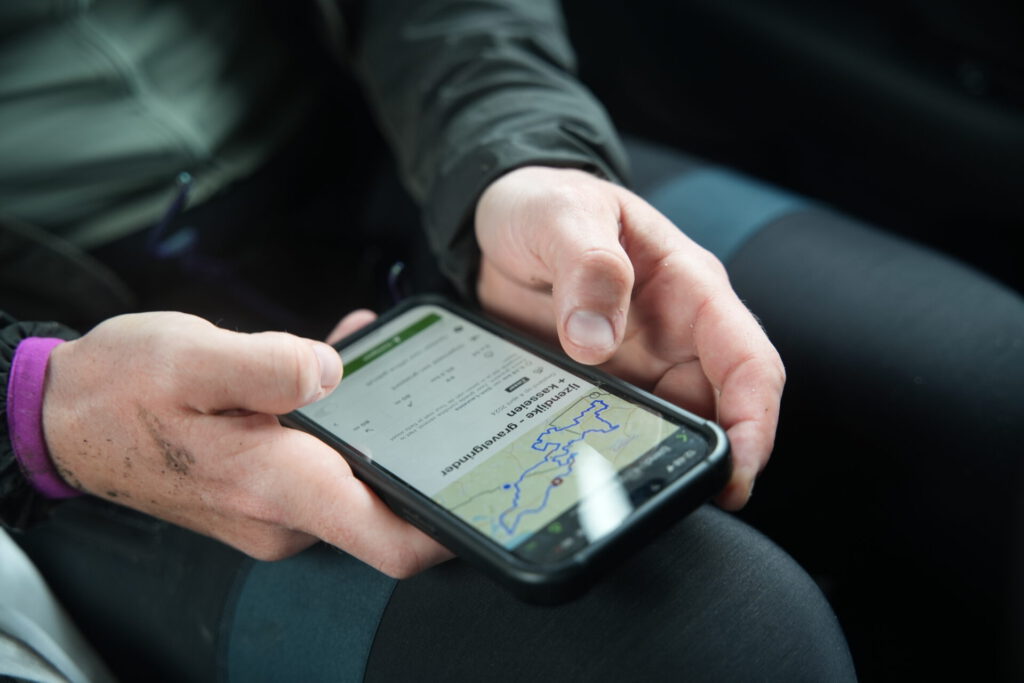
You are at the start of a gravel route somewhere in the Eifel with your bike. GPX loaded, Komoot open, weather app checked. Everything works. Until your phone suddenly switches to a Belgian network and you ask yourself: is this costing me something now? And how much? We dove in.
Range on the bike is not a luxury. You need it for navigation, for WhatsApp with your group, for finding that one boulangerie after 80km, and at worst for an emergency. Yet it is a topic that most cycling travellers only think about when things are already going wrong.
Three options you have: roaming, a local SIM or an eSIM. Which one do you need where?
Roaming - just turn on and go
The easiest option. You land, turn off aeroplane mode, and everything works. Your number stays active, you receive SMSes from your bank, you don't have to set anything up. For a weekend in the Ardennes or Vosges, this is often the best choice.
Within the EU, the well-known “Roam Like at Home”: you just use your own bundle, with no surcharge. New since January 2026: also Moldova and Ukraine are now covered by that scheme. Handy if you cycle there, but check if your provider has already implemented this. Oh and in the case of Ukraine: maybe also monitor the situation in the country. Just sayin’.
The pitfalls are outside Europe or what your provider does not consider Europe. The snags: Switzerland and Turkey. Those still like to change shape sometimes, provider dependent. The biggest pain, by the way, is when you are on open water. If you get on the boat at Hook of Holland or Harwich, and you're just out of range of the mast, you're on the sea satellite. And that's about €50. PER MB.
Non-European
Roaming in the US, Morocco or Thailand can quickly add up to a few euros per megabyte. And beware: satellite networks on cruise ships or in planes are NOT covered by EU roaming. There, your bill can soar by tens of euros within an hour. So: on the ferry? Wifi off, unless you are sure you are on a land network.
For UK travellers the situation is trickier after Brexit. Some providers (such as Tesco Mobile and certain O2 bundles) still offer free EU roaming, others charge a daily rate of around £2. Since 2026, Ofcom requires providers to send you an instant notification as soon as you pick up a foreign network, which is especially relevant on the coast near France or in Northern Ireland.
US travellers usually pay handsomely for roaming, unless they are with T-Mobile. Those offer 5 to 15GB of high-speed data in 215+ countries with many subscriptions, at no extra cost. Google Fi is another popular alternative for those who regularly cycle outside the US.
Local SIM - cheapest data, most hassle
Buying a local prepaid SIM is the budget-friendly option. You pay local rates, get a local phone number with it, and coverage is usually excellent. Ideal if you stay in one country for a few weeks and use a lot of data for navigation or remote working.
But there is a practical side to it. In Germany you have to go through a video identification or personal ID check before your SIM is activated. At Belgium passport registration is also mandatory. This takes time, and if you actually just want to get to your accommodation after a long flight, it is inconvenient.
Besides: you have to take out your home SIM (unless your phone supports dual SIM). That means no bank messages, no 2FA codes, no reachability on your home number. For a group ride with live tracking or when booking accommodation, this is inconvenient.
And do you travel through several countries? Then you'll need a new SIM for each country. That quickly becomes a collection of cards in your handlebar bag.
eSIM - digital, flexible, increasingly popular
An eSIM is a digital SIM profile that you install via a QR code or app. No physical card, no picking open a SIM drawer with a paperclip. You can set it up at home, before departure, and when you land, you are instantly online.
The big advantage for cycling travellers crossing borders: regional or global eSIM bundles cover several countries in one plan. You cycle from France to Switzerland to Italy without changing anything. Providers such as Airalo and Holafly offer this kind of package.
If you buy an e-sim through Holafly, use the code ‘GANNA’ to get 5% discount!
And because the eSIM works alongside your physical SIM (on phones with dual SIM), your home number remains active as usual. SMS from your bank? Coming in. WhatsApp on your home number? Works. Data runs through the eSIM. This combination offers both reachability and data.
Side notes: your phone must support eSIM. This applies to most iPhones from the XS onwards, Samsung Galaxy S20 and newer, and recent Google Pixels. Older devices drop out. In addition, many travel eSIMs are data-only: calls and SMSs are made via WhatsApp or Zoom, not via the regular phone screen. Some providers now do offer call and SMS support, but check beforehand.
For US travellers an additional detail is relevant: iPhones from the 14 onwards (US version) are fully eSIM-only, with no physical SIM tray. That actually makes the eSIM route the default.
Comparison at a glance
| Roaming | Local SIM | eSIM | |
|---|---|---|---|
| Setup | Nothing, automatically | Shop, ID, activation | QR code or app, ready at home |
| Cost (EU) | Own bundle, no surcharge | Cheapest | Middle |
| Charges (outside EU) | Often expensive | Cheapest | Competitive |
| Multiple countries | Automatic (but expensive outside EU) | New SIM per country | Regional bundling possible |
| Home number active | Yes | No (unless dual SIM) | Yes (dual SIM) |
| Navigation-proof | Yes, but speed may be disappointing | Yes, fastest local network | Yes |
| 2FA/bank messages | Yes | No | Yes (via home SIM) |
Before you leave - just check
Regardless of which option you choose, a few things to bear in mind:
- Download your GPX routes and offline maps (Komoot, Google Maps) before departure. Then you won't be dependent on range in a mountain valley.
- Check if your phone supports eSIM if you want to go that way.
- Check your bundle: how much data can you use abroad? Some providers apply fair use limits, including within the EU.
- Travelling in pairs? One good data bundle plus hotspot may be enough. Do pay attention to battery consumption.
- Avoid public wifi at campsites and hotels for banking unless you use a VPN.
So: what are you taking?
For a weekend within the EU: roaming is fine, you won't notice anything. Going away for longer, to one country outside Europe? A local SIM is cheapest. Are you travelling through several countries with the gravel bike? Then an eSIM is the best option.
We're curious: what do you use on the road? Do you have an eSIM provider that worked well in Norway, Morocco or the US? Or did you get completely stranded somewhere with no coverage? We'd love to hear about it!